Why Choose Carbon Fiber Sheets for Your Project?
carbon fiber sheets attract attention for their dark finish and impressive stiffness, but appearance alone is a poor reason to choose them. Their performance depends on fiber direction, sheet thickness, resin system, and how the part will be supported. A flat panel carrying a steady load has different needs from a bracket exposed to vibration or repeated impacts. Small details matter.
Composite materials educator Dr. Autar K. Kaw’s work offers a useful engineering lens. A concise design principle is: “Choose the sheet for the load, not the look.” This is an editorial paraphrase, not a verified quotation from Dr. Kaw. It captures an important point: carbon fiber sheets are not automatically the strongest or most suitable option for every project. Compare product data, including layup, thickness, strength direction, and temperature limits. Check how the sheet can be cut and finished, too; rough edges and poorly planned holes can compromise a part. A glossy surface may look precise while hiding a mismatch between the material and the job.
Used thoughtfully, these sheets can provide high stiffness with relatively low weight in panels, covers, fixtures, and custom components. Yet carbon fiber can cost more than common alternatives, and its properties vary across products. Ask suppliers for technical data, then match it to real loads and working conditions. That extra check may feel tedious. It is still worth doing.
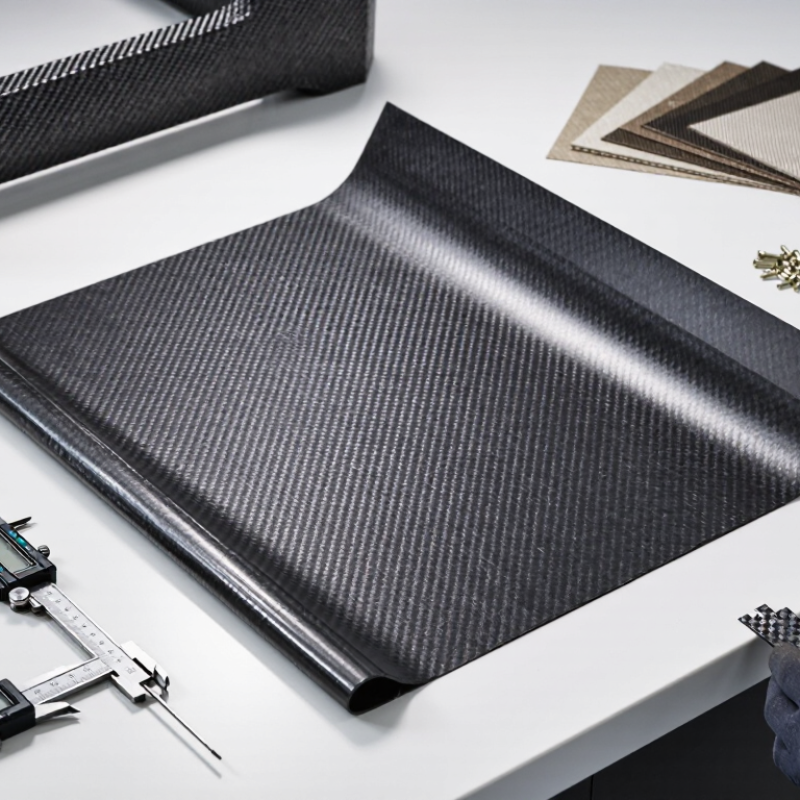
Define Carbon Fiber Sheets: Reinforcing Fibers, Resin, and Layup
A carbon fiber sheet is a composite, not a solid slab of woven fiber. It combines thin carbon filaments with a resin matrix, usually arranged in one or more layers. The fibers carry much of the load, while the cured resin holds them in place and transfers stress between them. Not just black fabric. The visible surface may show a weave, but appearance alone does not reveal the sheet’s internal construction.
Layup describes how those layers are stacked and oriented. Fibers running in one direction provide strength mainly along that direction; adding layers at different angles can improve performance across more directions. For example, a flat panel with alternating 0- and 90-degree layers behaves differently from one built with mostly aligned fibers. Orientation matters. Resin type, layer count, and curing quality also affect stiffness, weight, and resistance to heat or impact.
When choosing a sheet, check its thickness, fiber orientation, and product data rather than relying on color or surface pattern. A smooth face can hide a complex layup. It is easy to assume that more layers always mean a better part, but extra material may add weight without solving the actual load problem. That trade-off deserves a closer look.
Compare Typical CFRP Density (1.5–1.6 g/cm³) with Steel (7.85 g/cm³)
Carbon fiber reinforced polymer (CFRP) typically has a density of about 1.5–1.6 g/cm³, while steel is around 7.85 g/cm³. For equal volumes, a one-liter piece of CFRP weighs roughly 1.5–1.6 kilograms; the steel piece weighs about 7.85 kilograms. A big gap. This difference can make panels easier to lift, position, and support, especially in projects where every kilogram affects handling or overall mass.
Density alone does not tell you how a sheet will perform. CFRP stiffness and strength depend on fiber direction, laminate construction, resin, and thickness. A thin sheet may be light, yet flex more than expected when spanning between supports. Steel may be heavier, but its behavior and properties are often more familiar to designers and fabricators. Not the whole story.
For a real comparison, check the sheet’s stated density and weigh a sample if the final mass matters. Then consider the complete part, including fasteners, bonded joints, and any protective layers. A carbon laminate can reduce mass substantially, but the best choice depends on loads, geometry, and manufacturing quality. I would not choose by density alone; it is a useful starting point, not a performance guarantee.
Why Choose Carbon Fiber Sheets for Your Project? — CFRP vs. Steel
| Comparison | Carbon Fiber Reinforced Polymer (CFRP) | Steel |
| Typical density | Approximately 1.5–1.6 g/cm³ | Approximately 7.85 g/cm³ for common carbon steels |
| Mass of 1 m³ | Approximately 1,500–1,600 kg | Approximately 7,850 kg |
| Mass of a 100 × 100 × 1 mm plate | Approximately 15–16 g | Approximately 78.5 g |
| Mass difference at equal volume | About 80% lighter than steel, based on the typical densities above | Reference material |
| Strength and stiffness behavior | Can provide high strength and stiffness for its mass. Properties depend strongly on fiber direction, laminate design, and manufacturing. | Generally has more uniform properties in different directions and well-established structural design data. |
| Corrosion resistance | The polymer matrix does not rust, though resin choice, exposed fibers, joints, and the surrounding environment matter. | Many grades can corrode in moist or chemically aggressive environments; coatings or other protection may be needed. |
| Electrical behavior | Carbon fibers conduct electricity; conductivity varies with fiber direction and laminate construction. | Electrically conductive. |
| Thermal behavior | Depends on fiber direction and resin. CFRP often conducts heat differently along and across the fibers. | Conducts heat; properties vary by steel grade and temperature. |
| Typical project advantage | Useful when low mass, directional performance, or corrosion resistance is a priority. | Useful when low material cost, ductility, isotropic behavior, and established joining methods are priorities. |
Note: Values are typical comparisons, not design specifications. Actual CFRP density and mechanical properties vary with fiber type, resin content, laminate architecture, and manufacturing process; steel values vary by grade.
Understand Fiber Strength: Commercial Carbon Fibers Reach 3.5–7 GPa
Commercial carbon fibers are often reported with tensile strengths around 3.5–7 GPa. That number describes the fibers themselves, not a finished carbon fiber sheet. It indicates how much pulling stress a fiber can withstand before breaking under specified test conditions. Impressive, but easy to misread. A sheet is a composite, and its strength depends on how fibers and resin work together.
Fiber direction matters. A unidirectional sheet can be very strong along its fibers, yet less resistant to loads across them. Woven sheets spread fibers in multiple directions, but the weave and resin add their own effects. Imagine a thin panel supporting a bracket: a hole, an abrupt edge, or a poorly aligned load can create a weak point even when the raw fiber rating is high. Small details matter.
When comparing materials, check whether a specification refers to fiber, laminate, or finished-part strength. Also look for test direction, thickness, and test method. In practical work, a clean cut and careful fit can help, but they cannot replace sound design. I would not choose a sheet from the GPa figure alone; it is a useful starting point, not a promise of performance.
Assess Directional Stiffness, Fatigue Resistance, and Design Trade-Offs
Carbon fiber sheets can feel exceptionally stiff, but their stiffness depends on fiber direction. A panel resists bending best along its reinforced fibers, not equally in every direction. Direction matters. Before specifying a sheet, sketch the main loads: a bracket may flex across its width, while a flat cover may twist near its fasteners. Aligning fibers with one load can leave another less supported.
Fatigue resistance also depends on the whole assembly. Repeated vibration, sharp corners, drilled holes, and uneven clamping can concentrate stress. A useful check is to inspect the edges and mounting points, where damage may begin before the center shows visible bending. Carbon fiber often handles repeated loading well, but that does not make every layup immune to cracks or delamination. Testing the actual part under expected cycling is more reliable than relying on a material label.
Design brings trade-offs. A thicker sheet may add stiffness, yet increase weight, cost, and machining difficulty. A carefully oriented laminate can use material more efficiently, though it may complicate cutting and joining. It is tempting to optimize for one clean load case. Real projects are messier. Leave room for fasteners, support the panel where loads enter, and question whether a metal insert or different fiber orientation would solve the problem better.
Match Sheet Grade, Thickness, and Cost to Your Project’s Requirements
Choosing a carbon fiber sheet starts with the load it must carry, not the finish you prefer. A flat equipment panel may need modest stiffness, while a camera mount or test fixture may face repeated vibration. Sheet grades and labels vary between suppliers, so check the laminate schedule, fiber orientation, and published properties. A glossy surface alone says little about strength.
Thickness is only part of the decision. A thicker sheet can resist bending, but it may add weight and require more clearance. Fiber direction matters too: a panel can feel rigid one way and flex more across its width. For a small bracket, cut a sample and test it under a load similar to the real application. Not always practical. Still useful. If failure would be costly or unsafe, ask a qualified engineer to review the design.
Match cost to the job’s actual demands. Standard panels may suit covers and light-duty fixtures; specialized laminates can make sense when weight, stiffness, or temperature performance is critical. Compare usable sheet size, thickness tolerance, surface quality, and machining needs—not just price per sheet. Cutting can create rough edges, and tight tolerances may raise fabrication costs. It is easy to over-specify. I would rather verify the load and dimensions first than pay for properties the project never uses.