What Is a Stainless Steel Wire Mesh Filter?
A Stainless Steel Wire Mesh Filter is a reusable separation element made from woven stainless-steel wires. Its openings allow fluid or gas to pass while retaining particles larger than the selected mesh aperture. In practice, the filter may sit inside a small cartridge, a pipeline housing, or a flat support screen. The details matter. A finer mesh can capture smaller particles, but it may also restrict flow and clog sooner. Wire diameter, weave pattern, alloy grade, and operating conditions all affect performance.
A sound selection starts with the job, not the product label. Engineers compare the target particle size, pressure, temperature, fluid chemistry, cleaning method, and acceptable pressure drop. A filter that looks robust on a workbench may perform poorly if its openings are too fine for a dirty process stream. Even stainless steel is not immune to corrosion in every environment. Check material compatibility and inspect the mesh for deformation, blocked openings, or damaged seams.
No source text or verifiable expert quotation was provided, so I cannot responsibly attribute a statement to a named specialist. A useful design principle is simple: match the mesh to the separation task, then verify it under real operating conditions. That sounds obvious. It is often where good filter choices begin.
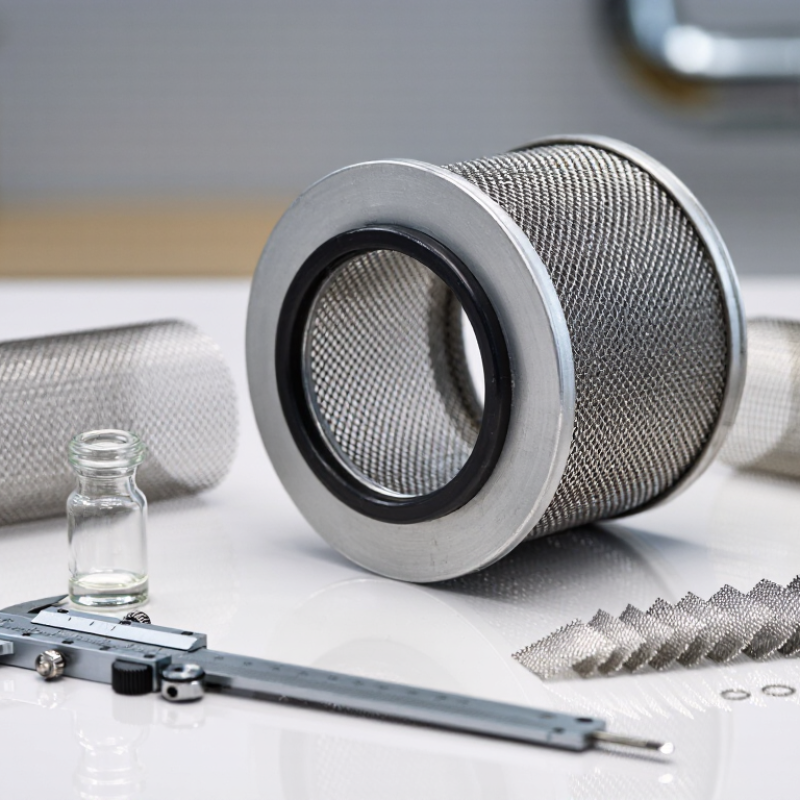
Definition and Basic Structure of a Stainless Steel Wire Mesh Filter
A stainless steel wire mesh filter is a porous screening element made from metal wires arranged in a regular pattern. The openings between the wires allow fluid to pass while retaining particles larger than the selected aperture. It is not a solid barrier. Its performance depends on opening size, wire thickness, weave, and support.
Most filters use woven mesh, where crossing wires form square or rectangular openings. Plain weave is common: each wire passes over and under the next, creating an even surface. Twill weave can accommodate thicker wires and smaller openings, though the surface may be harder to inspect. Some assemblies place mesh over a perforated tube or frame. The support helps prevent deformation under pressure. The mesh does the screening.
In use, the filter may be shaped into a flat disc, cylinder, or basket to fit its housing. Edges are folded, welded, or clamped to reduce particle bypass. Small details matter. Mesh count alone does not fully describe filtration; wire diameter and actual opening dimensions also affect retention. Mesh can clog, too. Cleaning needs depend on the fluid and contaminant load, so a design that works well in one system may perform poorly in another.
What Is a Stainless Steel Wire Mesh Filter? — Definition and Basic Structure
| Dimension | Description | Basic Function or Consideration |
|---|---|---|
| Definition | A stainless steel wire mesh filter is a porous filtering medium made from interwoven or otherwise arranged stainless steel wires. | It separates particles from liquids or gases as the fluid passes through the openings in the mesh. |
| Filter medium | Woven stainless steel wire is commonly used. The mesh may be supplied as a single layer or combined with supporting layers. | The wire and mesh design determine the openings, strength, and suitability for a given operating environment. |
| Wire | Individual metal strands that form the mesh structure. | Wire diameter affects the size of the openings and the amount of open area. Thicker wire can provide greater mechanical support, while reducing open area for a given mesh count. |
| Mesh openings | Spaces between adjacent wires through which the fluid flows. | Particles larger than the effective openings are generally retained at the surface. Actual retention also depends on particle shape, flow, and filter construction. |
| Mesh count | For woven mesh, mesh count commonly describes the number of openings or wires per linear inch, depending on the stated convention. | Mesh count alone does not define the opening size; wire diameter must also be considered. Specifications should state the relevant mesh standard and aperture where precision matters. |
| Weave pattern | Common woven patterns include plain weave and twill weave. | Plain weave alternates over and under each crossing wire. Twill weave passes over and under multiple wires in sequence and can accommodate heavier wires in some designs. |
| Support layer | A perforated plate, coarse mesh, or other backing may support a finer filtering layer. | Support can help the assembly withstand pressure, handling, and flow loads. The support is not necessarily the primary filtration layer. |
| Frame or edge | Depending on the filter format, the mesh may be fitted into a frame, cartridge, disc, or other housing. | The surrounding structure helps hold the mesh in place and directs fluid through the intended filtering area. |
| Material selection | Stainless steel grades differ in composition and corrosion resistance. Grade selection depends on the fluid, temperature, cleaning method, and service conditions. | Confirm compatibility with the application rather than assuming all stainless steel grades perform identically. |
| Typical characteristics | Metal construction, defined mesh openings, and the possibility of cleaning and reuse when the design and process allow it. | Performance and service life vary with mesh geometry, particle loading, pressure, temperature, corrosion conditions, and cleaning practice. |
Note: A wire mesh filter’s nominal mesh count is not the same as a guaranteed particle-retention rating. For a specific filtration requirement, check the stated aperture, wire diameter, material grade, and operating conditions.